Bactostore
Sugarcane Press Mud Decomposer
Sugarcane Press Mud Decomposer
Couldn't load pickup availability
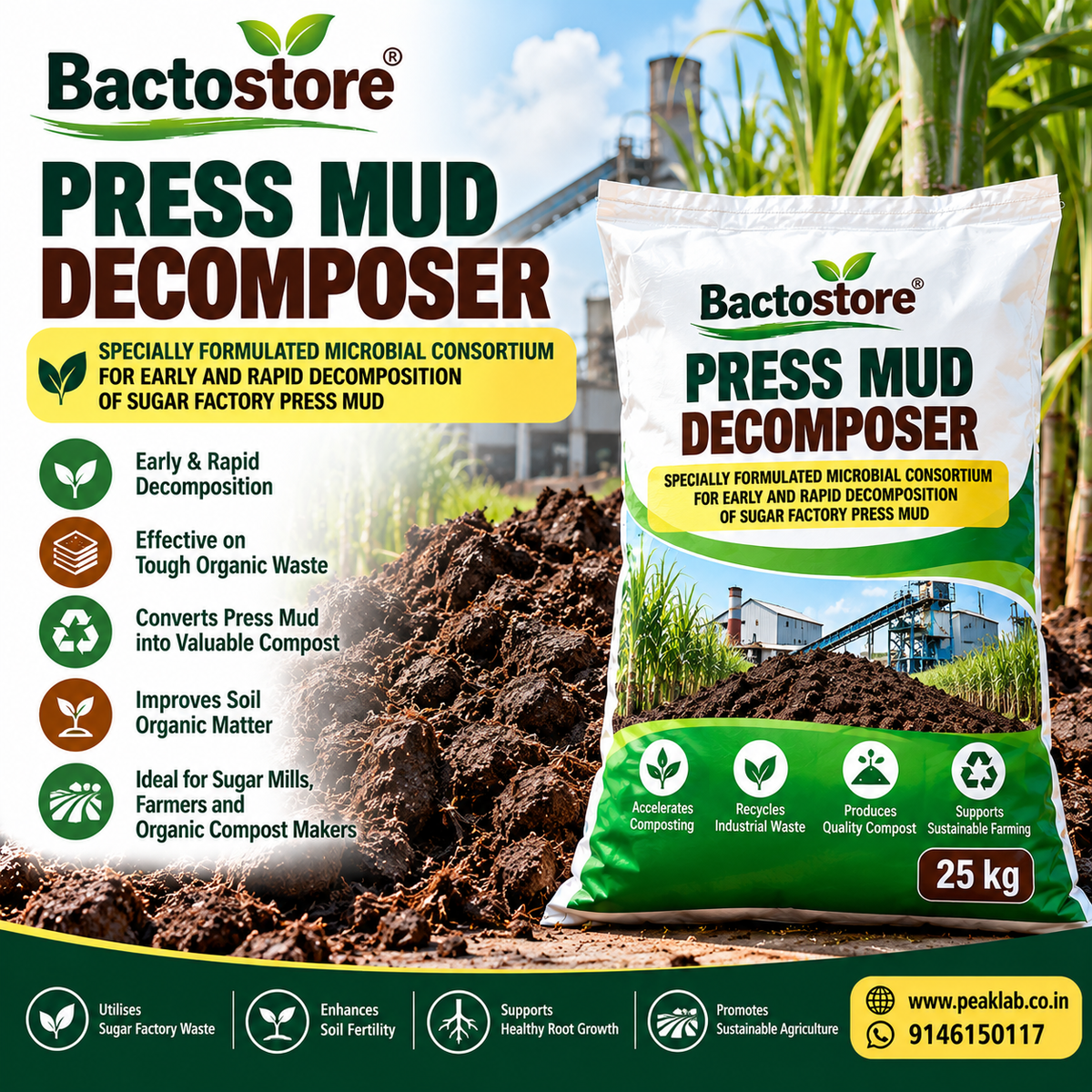
Bactostore Press Mud Decomposer – 25 kg Bag is a specially formulated microbial consortium developed to support early and rapid biological decomposition of sugar factory press mud (filter cake), an organic by-product generated during sugarcane processing.
Press mud contains organic matter, fibrous residues, waxes, proteins and plant nutrients. Although it has considerable potential as an organic soil amendment, fresh press mud requires appropriate decomposition and stabilization before agricultural application.
Our specially formulated decomposer microorganisms are designed to initiate microbial activity at an early stage, support the breakdown of biodegradable organic components and promote efficient composting under suitable conditions.
The product is particularly suitable for sugar mills, organic compost manufacturers, agricultural waste processors, sugarcane farmers and commercial composting operations.
By supporting biological decomposition, Press Mud Decomposer helps convert sugar industry organic residues into valuable compost for agricultural use.
Key Benefits of Press Mud Decomposer
✅ Specially Formulated Microbial Consortium: Contains selected beneficial microorganisms developed for press mud decomposition.
✅ Early Decomposition: Designed to initiate microbial decomposition during the initial composting stages.
✅ Rapid Biological Breakdown: Supports faster degradation of biodegradable organic components under appropriate composting conditions.
✅ Sugar Factory Waste Management: Helps manage press mud generated during sugarcane processing.
✅ Organic Compost Production: Supports conversion of press mud into stabilized organic compost.
✅ Organic Matter Recycling: Helps recycle organic residues and nutrients into agricultural soil amendments.
✅ Supports Soil Health: Properly matured compost contributes organic matter and can improve soil physical properties.
✅ Suitable for Bulk Composting: Ideal for sugar mills, commercial compost producers and large agricultural operations.
Why Does Sugar Factory Press Mud Need Decomposition?
Press mud, also known as sugarcane filter cake, is produced during the clarification and filtration stages of sugar manufacturing.
Fresh press mud contains moisture, organic matter, fibrous plant residues and various nutrients.
Direct application of large quantities of fresh, undecomposed press mud may create problems such as:
- Unpleasant odours during uncontrolled decomposition.
- Uneven nutrient release.
- Temporary microbial immobilization of available nutrients.
- Poor handling and storage characteristics.
- Anaerobic decomposition in excessively wet material.
- Potential phytotoxicity when insufficiently stabilized.
Proper microbial composting helps stabilize press mud and improve its suitability for agricultural use.
How to Use Press Mud Decomposer
Step 1 – Prepare Microbial Fermentation Solution
Mix the following ingredients in a clean plastic drum:
Press Mud Decomposer: 1 kg
Jaggery: 1 kg
Besan (Gram Flour): 500 grams
Clean Water: 200 litres
Mix thoroughly to prepare the microbial solution.
Step 2 – Fermentation
- Allow the prepared solution to ferment for 3–4 days in a shaded location.
- Stir periodically and keep the container loosely covered to allow gas release.
- Use clean equipment and avoid contamination.
- Note: The fermentation method should be validated for the microorganisms present in the formulation.
Step 3 – Prepare Press Mud Material
- Collect the sugar factory press mud and arrange it in a suitable composting area.
- Break large lumps to improve aeration and uniform microbial distribution.
Ensure the press mud is uniformly moist before applying the decomposer solution.
Press mud often already contains substantial moisture. Add water only when necessary.
Step 4 – Apply Fermented Decomposer Solution
- Spray the fermented microbial solution uniformly over the prepared press mud.
- Apply the solution layer by layer to ensure even distribution throughout the material.
- Avoid excessive wetting or waterlogging.
Step 5 – Regular Turning Is Necessary
Regular turning is essential for effective aerobic decomposition.
Turning helps:
- Improve oxygen availability.
- Distribute microorganisms uniformly.
- Maintain consistent moisture.
- Prevent anaerobic conditions.
- Improve composting efficiency.
- Support uniform decomposition throughout the pile.
Step 6 – Maintain Proper Composting Conditions
- Maintain approximately 50–60% moisture, suitable aeration and appropriate composting temperatures.
- Monitor the material periodically and turn as required.
- Continue composting until the press mud becomes sufficiently stabilized and mature.
- Composting time varies depending on temperature, moisture, aeration, microbial activity, pile size and the characteristics of the press mud.
Recommended Fermentation Formula
1 kg Press Mud Decomposer + 1 kg Jaggery + 500 g Besan + 200 Litres Water
Fermentation Period: 3–4 Days
Application Method: Uniform spraying over prepared press mud.
Important: The amount of press mud treated by 1 kg of decomposer depends on the microbial formulation and validated application rate. The above ratio describes solution preparation, not the treatment capacity per tonne.
Suitable Applications
Sugar Factory Press Mud Composting
Designed for biological composting of press mud generated by sugar manufacturing facilities.
Commercial Organic Compost Manufacturing
Suitable for compost manufacturers processing sugar industry organic residues.
Sugarcane Farm Waste Management
Useful for agricultural operations that compost press mud for subsequent use in sugarcane cultivation.
Organic Manure Production
Supports preparation of stabilized organic compost for use in agriculture.
Integrated Agricultural Waste Recycling
Can be incorporated into suitable composting systems involving press mud and compatible biodegradable agricultural materials.
Who Can Use Press Mud Decomposer?
- Sugar factories and sugar mills
- Sugarcane farmers
- Organic compost manufacturers
- Agricultural waste processing units
- Commercial composting facilities
- Organic fertilizer manufacturers
- Farmer producer organizations
- Agricultural cooperatives
- Large-scale farming operations
Why Choose Bactostore Press Mud Decomposer?
Bactostore Press Mud Decomposer is developed specifically for biological management of sugar factory press mud.
Unlike general-purpose composting products, this formulation is intended for the particular organic waste characteristics of sugarcane press mud.
Its specially formulated microbial consortium is designed to support early microbial activity and efficient biological decomposition.
Key Product Highlights
✔ Specially formulated for sugar factory press mud.
✔ Microbial consortium for early and rapid decomposition.
✔ Suitable for large-scale composting.
✔ Supports organic waste recycling.
✔ Helps produce valuable organic compost.
✔ Convenient 25 kg bulk packaging.
✔ Manufactured by Peak Laboratories.
Storage Instructions
- Store the product in a cool, dry and shaded location.
- Keep away from direct sunlight, excessive heat and moisture.
- Keep the packaging properly sealed until application.
- Avoid direct mixing with chemical disinfectants, fungicides or other antimicrobial substances.
- Follow the product label for shelf life and storage conditions.
Frequently Asked Questions
What is Press Mud Decomposer?
Press Mud Decomposer is a specially formulated microbial product designed to support biological decomposition of sugar factory press mud.
Can press mud be converted into organic compost?
Yes. Press mud can be converted into organic compost through properly managed biological composting.
Why is turning necessary during press mud composting?
Turning improves aeration, distributes microorganisms and helps prevent anaerobic conditions.
Can Press Mud Decomposer be used by sugar factories?
Yes. The product is intended for sugar factories and commercial composting operations processing press mud.
How long does press mud take to decompose?
The duration depends on the characteristics of the press mud, moisture, temperature, aeration, pile size and microbial activity. A fixed decomposition period cannot be guaranteed.
Can decomposed press mud be applied to agricultural soil?
Yes. Properly matured and quality-tested press mud compost can be used as an organic soil amendment according to soil and crop requirements.
Share