Bactostore
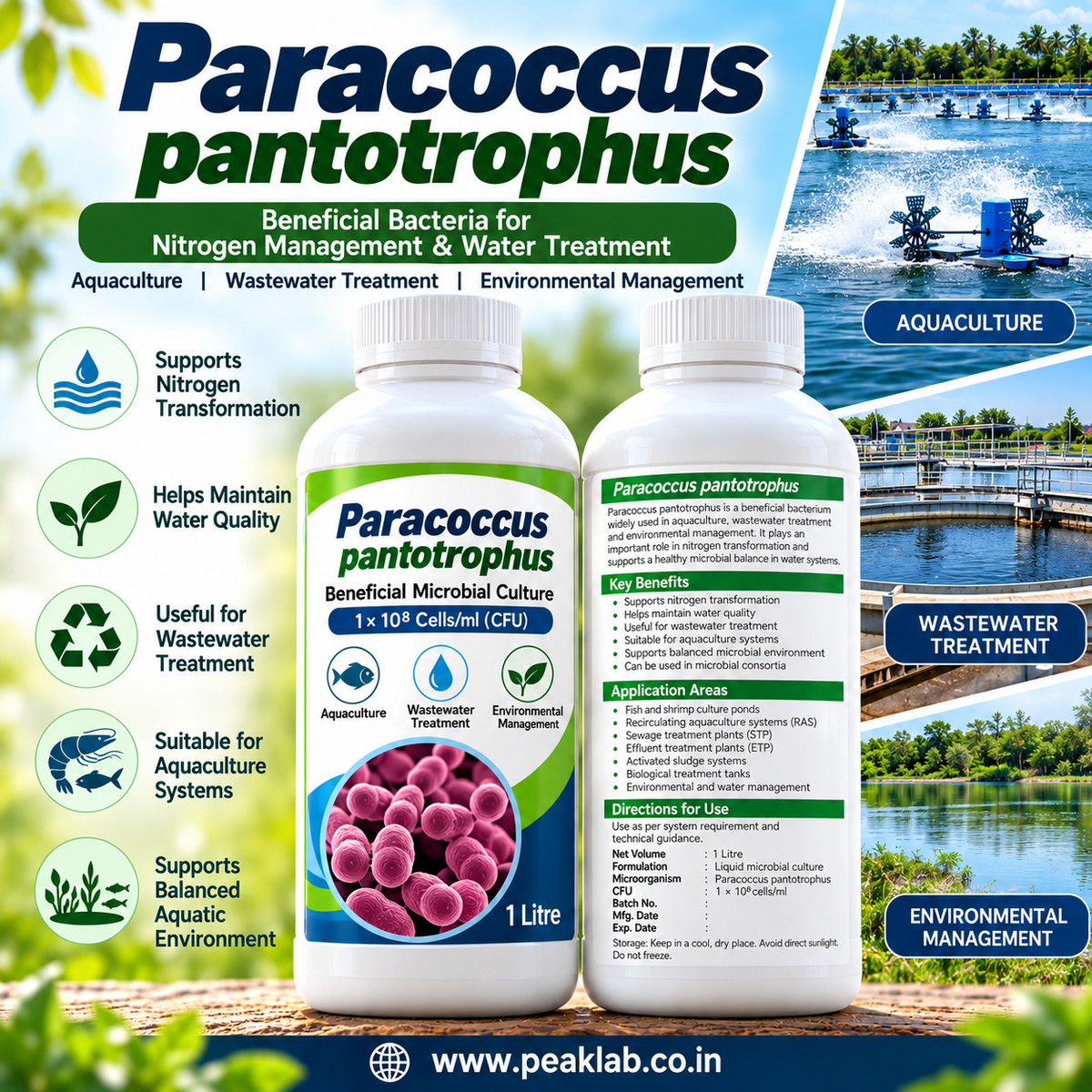
Paracoccus pantotrophus 1L | Aquaculture & Wastewater Management
Paracoccus pantotrophus 1L | Aquaculture & Wastewater Management
Couldn't load pickup availability
CFU: 1 × 10⁸ Cells/ml | Beneficial Microbial Culture | Nitrogen Transformation | Aquaculture & Wastewater Management
Paracoccus pantotrophus is a metabolically versatile beneficial bacterium used in microbial systems associated with biological nitrogen transformation, wastewater treatment, aquaculture water management and nutrient cycling.
This concentrated liquid formulation contains 1 × 10⁸ cells/ml, providing a high viable microbial population for use in appropriately designed biological treatment and microbial management programs.
Product Specifications
Microorganism: Paracoccus pantotrophus
CFU: 1 × 10⁸ cells/ml
Formulation: Liquid Microbial Culture
Pack Size: 1 Litre Bottle
Type: Beneficial Environmental Bacteria
Primary Applications: Aquaculture, Wastewater Treatment & Biological Nitrogen Management
Country of Origin: India
Key Benefits
Supports Biological Nitrogen Transformation
Paracoccus pantotrophus participates in microbial nitrogen-transformation processes and can be incorporated into biological nitrogen-management systems.
Supports Denitrification
Suitable strains can participate in nitrate reduction under appropriate environmental and process conditions.
Supports Wastewater Treatment
Useful in microbial programs developed for biological wastewater and effluent-treatment systems.
Aquaculture Water Management
Can be incorporated into appropriately designed microbial programs for fish and shrimp culture systems.
Supports Nutrient Cycling
Its metabolic versatility makes Paracoccus pantotrophus useful in biological systems involving nutrient transformation.
High Microbial Concentration
Formulated at 1 × 10⁸ cells/ml for commercial microbial applications.
Wastewater Treatment Applications
Suitable for microbial programs involving:
- Wastewater Treatment Plants (WWTP)
- Sewage Treatment Plants (STP)
- Effluent Treatment Plants (ETP)
- Activated sludge systems
- Biological treatment tanks
- Biofilter systems
- Biological nitrogen management
- Nitrate management
- Denitrification processes
- Organic-load management
Aquaculture Applications
Can be incorporated into microbial programs for:
- Fish ponds
- Shrimp ponds
- Aquaculture tanks
- Recirculating aquaculture systems (RAS)
- Pond microbial management
- Nitrogenous waste management
- Organic-load management
- Biological water treatment
Biological Nitrogen Management
Nitrogenous compounds can accumulate in wastewater and aquaculture systems due to organic matter, feed residues, animal waste and other nitrogen-containing materials.
Paracoccus pantotrophus is useful in biological treatment research and applications because of its ability to participate in nitrogen transformation pathways.
Actual performance depends on factors including strain characteristics, dissolved oxygen, available carbon, pH, temperature, salinity, nitrogen load and hydraulic retention time.
Microbial Consortium Applications
Paracoccus pantotrophus can be incorporated into properly designed microbial consortia with compatible microorganisms selected for:
- Nitrogen transformation
- Denitrification
- Organic matter degradation
- Sludge management
- Aquaculture water management
- Wastewater biological treatment
Compatibility and stability of individual strains should be evaluated before developing multi-microbial commercial formulations.
Directions for Use
Application dosage depends on water volume, nitrogen load, organic load, CFU requirement, dissolved oxygen, pH, salinity and treatment objective.
For wastewater systems, determine dosage according to influent characteristics, treatment capacity and biological process requirements.
For aquaculture applications, determine dosage according to pond volume, stocking density, feed load and water-quality parameters.
Use according to technical recommendations and applicable product-label requirements.
Storage
Store in a cool and dry place away from direct sunlight and excessive heat. Keep the bottle tightly closed and protect it from contamination and extreme temperatures.
Share