Bactostore
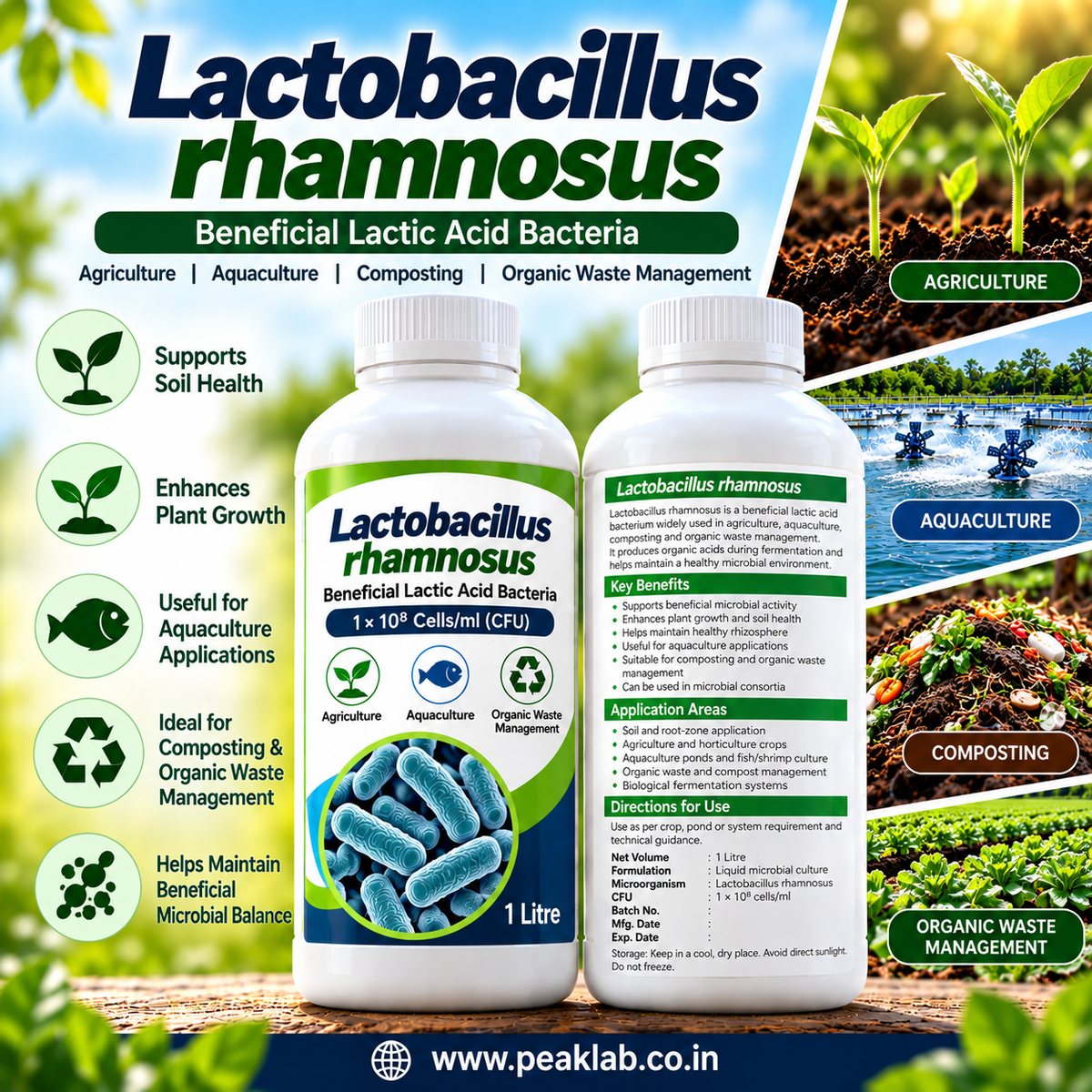
Lactobacillus rhamnosus Liquid – 1 Litre
Lactobacillus rhamnosus Liquid – 1 Litre
ಪಿಕಪ್ ಲಭ್ಯತೆಯನ್ನು ಲೋಡ್ ಮಾಡಲು ಸಾಧ್ಯವಾಗಲಿಲ್ಲ.
CFU: 1 × 10⁸ Cells/ml | Beneficial Lactic Acid Bacteria | Microbial Culture
Lactobacillus rhamnosus is a beneficial lactic acid bacterium (LAB) known for its fermentation capabilities and production of organic acids and other microbial metabolites.
This liquid microbial culture contains 1 × 10⁸ cells/ml and is suitable for appropriately designed microbial programs involving agriculture, aquaculture, organic waste management, composting and biological fermentation.
Product Specifications
Microorganism: Lactobacillus rhamnosus
CFU: 1 × 10⁸ cells/ml
Formulation: Liquid Microbial Culture
Pack Size: 1 Litre Bottle
Type: Beneficial Lactic Acid Bacteria (LAB)
Application Areas: Agriculture, Aquaculture, Composting, Fermentation & Organic Waste Management
Country of Origin: India
Key Benefits
Supports Beneficial Microbial Activity
Can contribute to beneficial microbial populations when incorporated into appropriately managed biological systems.
Lactic Acid Production
Lactobacillus rhamnosus produces lactic acid during carbohydrate fermentation, an important characteristic of lactic acid bacteria.
Supports Biological Fermentation
Can be incorporated into microbial formulations and fermentation programs where LAB activity is required.
Supports Organic Matter Management
Suitable for appropriately designed microbial programs involving organic substrates and biological waste management.
Useful for Composting Programs
Can be incorporated into microbial consortia developed for compost, farm residues and organic waste.
Aquaculture Applications
Can be considered as a component of appropriately formulated microbial programs for fish and shrimp culture systems.
Suitable for Microbial Consortia
Can be combined with compatible beneficial microorganisms in properly developed multi-microbial formulations.
High Microbial Concentration
Formulated at 1 × 10⁸ cells/ml for commercial microbial applications.
Agricultural Applications
Lactobacillus rhamnosus can be incorporated into microbial programs involving:
Soil and root-zone microbial applications
Organic farming systems
Agricultural microbial consortia
Organic matter management
Farm residue management
Composting programs
Biological fermentation systems
Aquaculture Applications
Can be incorporated into appropriately designed microbial programs involving:
- Fish culture ponds
- Shrimp culture ponds
- Aquaculture tanks
- Microbial pond management
- Organic-load management
- Biological water-management systems
Dosage and suitability should be determined according to the specific aquaculture system and intended application.
Compost & Organic Waste Applications
Potential microbial applications include:
- Composting
- Crop residue management
- Farm waste treatment
- Organic waste fermentation
- Manure management
- Organic matter management
- Biological waste-treatment programs
Fermentation Applications
Lactobacillus rhamnosus utilizes fermentable carbohydrates and produces lactic acid. This makes it relevant to microbial fermentation systems where LAB activity and biological acidification are desired.
Performance depends on factors such as substrate availability, temperature, pH, microbial population and fermentation conditions.
Microbial Consortium Applications
Lactobacillus rhamnosus may be incorporated into properly designed microbial consortia alongside compatible beneficial microorganisms.
Potential consortium applications include:
- Agricultural microbial formulations
- Organic waste microbial formulations
- Composting cultures
- Aquaculture microbial products
- Fermentation cultures
- Multi-strain biological products
Compatibility, formulation stability and final viable microbial count should be evaluated before commercial production.
Directions for Use
Application dosage depends on CFU concentration, intended application, crop, soil conditions, water volume, organic load and treatment objective.
For agricultural applications, determine dosage according to crop, soil and formulation requirements.
For aquaculture, determine dosage according to pond volume, stocking density, feed load and water-quality conditions.
For composting and waste-management applications, dosage depends on the quantity, moisture and characteristics of the organic material.
Use according to the product label and technical recommendations.
Storage
Store in a cool, dry place away from direct sunlight and excessive heat. Keep the container tightly closed. Protect from contamination and extreme temperatures. Avoid freezing unless specifically recommended for the formulation.
ಹಂಚಿ